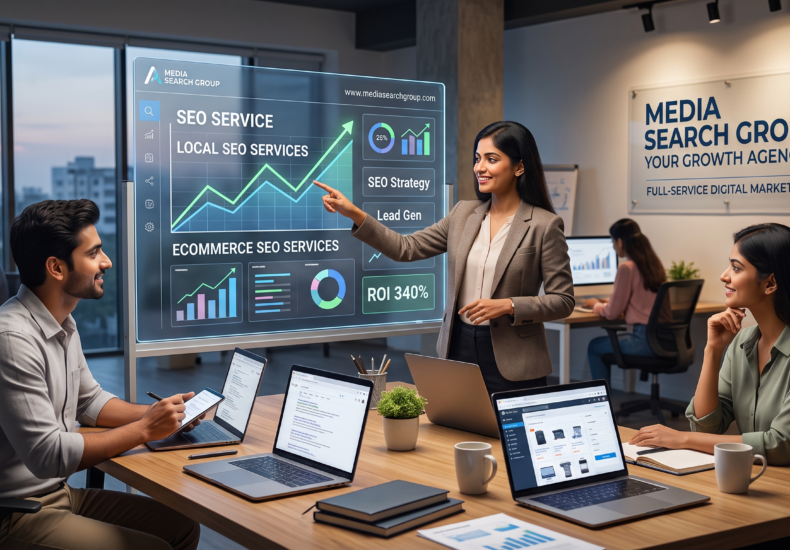
Full-Service Digital Marketing Agency | SEO, PPC & Social Media
Building a successful business today requires more than having a good product, an attractive website, or a presence on social media. Customers discover brands through search engines, social platforms, paid advertisements, online reviews, marketplace listings, videos, blogs, and increasingly, AI-powered search experiences. With so many touchpoints influencing purchasing decisions, businesses need a coordinated approach to digital growth.

This is where a digital marketing agency can make a meaningful difference.
Instead of treating SEO, paid advertising, content, social media, analytics, and conversion optimization as isolated activities, a strategic agency can connect them into one growth system. The goal is not simply to generate website traffic. It is to attract the right audience, build trust, convert visitors into customers, and use performance data to continuously improve results.
For startups, small businesses, ecommerce companies, and established brands, this integrated approach can make digital marketing more predictable and scalable.
Why Digital Marketing Has Become a Business Growth Function
Digital marketing was once viewed primarily as a promotional channel. Today, it is closely connected to almost every stage of the customer journey.
A potential customer might first discover a company through a Google search. They may then visit its website, read a blog post, compare competitors, check reviews, see a social media post, click a remarketing advertisement, and eventually make a purchase.
Each interaction contributes to the final decision.
This means businesses can no longer rely on a single channel to generate sustainable growth. Ranking well in search results is valuable, but rankings alone do not guarantee conversions. Similarly, running PPC campaigns can generate immediate visitors, but poor landing pages can waste advertising spend.
A successful strategy connects these activities.
A business may use organic search to capture long-term demand, paid advertising to target high-intent users, content marketing to answer customer questions, social media to strengthen brand recognition, and conversion optimization to turn more visitors into leads or buyers.
The result is a marketing ecosystem rather than a collection of disconnected campaigns.
What Does a Digital Marketing Agency Actually Do?
A professional marketing partner typically combines multiple disciplines to help businesses achieve measurable objectives.
The exact strategy depends on the company’s industry, audience, competition, budget, website, and growth stage. However, several core areas form the foundation of most successful campaigns.
1. Search Engine Optimization
Search engines remain one of the most important ways customers find products, services, businesses, and information.
SEO helps a website become more discoverable for relevant searches. A comprehensive SEO strategy may include:
- Keyword and search-intent research
- Technical website optimization
- On-page optimization
- Content development
- Internal linking
- Digital PR and link acquisition
- Website architecture improvements
- Local search optimization
- Ecommerce optimization
- Performance monitoring
Quality seo services should focus on more than increasing keyword rankings. The real objective is to attract qualified visitors who have a genuine interest in what the business offers.
For example, ranking for a broad informational keyword may produce substantial traffic but few sales. A more specific commercial search may generate less traffic while producing significantly more valuable leads.
Understanding this difference is essential for creating an SEO strategy that contributes to revenue rather than vanity metrics.
2. Local Search Marketing
For businesses that depend on customers within a particular geographic area, visibility in local search can be extremely valuable.
Restaurants, clinics, law firms, home service companies, retailers, real estate businesses, educational institutions, and many professional services can benefit from a strong local presence.
A local search strategy can involve optimizing business profiles, improving location pages, managing citations, developing locally relevant content, earning reviews, and strengthening the website’s geographic relevance.
Businesses competing in crowded markets can use local seo services to improve their visibility when potential customers search for nearby products and services.
The important point is that local SEO should not be treated as simply adding a city name to a webpage. Search engines evaluate numerous signals when determining which local businesses deserve visibility.
Accurate business information, relevance, proximity, reputation, website quality, customer reviews, and local authority can all influence performance.
3. Paid Search and PPC
SEO is generally a long-term investment, while paid search can provide visibility much faster.
Pay-per-click advertising allows businesses to target users based on search queries, interests, demographics, geographic locations, and other signals. When managed properly, PPC can be a powerful source of qualified traffic and conversions.
However, simply increasing an advertising budget does not guarantee better results.
Effective PPC management involves:
- Audience research
- Campaign structure
- Keyword selection
- Ad copy testing
- Landing page optimization
- Bid and budget management
- Conversion tracking
- Search-term analysis
- Ongoing experimentation
The most important metric is not necessarily the number of clicks. Businesses should evaluate what happens after the click.
If 1,000 visitors generate only a handful of meaningful actions, the campaign may need better targeting or a stronger conversion experience.
Conversely, a smaller campaign that produces highly qualified leads can be far more valuable.
Content Marketing Turns Visibility Into Trust
Search visibility gets people to a website, but useful content gives them a reason to stay.
Content marketing helps businesses demonstrate expertise, answer customer questions, explain products, overcome objections, and establish credibility.
Effective content can take many forms:
- Blog articles
- Buying guides
- Case studies
- Product comparisons
- Industry reports
- Tutorials
- Videos
- Infographics
- FAQs
- Landing pages
- Email content
- Social media posts
The best content strategies start with the audience rather than the search engine.
Instead of asking, “What keyword should we target?” businesses should also ask:
- What problems does our audience have?
- What information do customers need before purchasing?
- What objections prevent people from converting?
- What questions do sales teams hear repeatedly?
- What makes our solution different?
- Which topics demonstrate genuine expertise?
These questions can reveal opportunities for content that is both useful to customers and valuable for organic search.
Social Media Is More Than a Brand Awareness Channel
Social platforms can support every stage of the marketing funnel.
At the awareness stage, social content can introduce a brand to new audiences. During consideration, educational posts, testimonials, videos, and demonstrations can build trust. At the conversion stage, offers, product content, retargeting, and social proof can encourage action.
The right platform depends on the audience and business model.
A B2B company may prioritize LinkedIn, while an ecommerce brand may place greater emphasis on Instagram, YouTube, Facebook, Pinterest, or other visual platforms.
The goal should not be to maintain an account on every platform.
Instead, businesses should identify where their customers spend time and develop content that fits the expectations of those platforms.
Social media also provides valuable audience insights. Comments, questions, engagement patterns, and content performance can reveal what customers care about, which can then inform SEO, content, advertising, and product strategies.
Ecommerce Requires a Different Approach
Ecommerce businesses face a unique challenge: they may have hundreds, thousands, or even millions of product and category pages competing for visibility.
Simply publishing products is not enough.
An ecommerce growth strategy needs to consider:
- Product-page optimization
- Category-page architecture
- Search intent
- Faceted navigation
- Internal linking
- Product descriptions
- Structured data
- Page speed
- Mobile usability
- Image optimization
- Duplicate content
- Indexation
- Customer reviews
- Conversion optimization
For online retailers, ecommerce seo can help connect product demand with relevant search visibility.
Consider a customer searching for a specific product category. A well-optimized category page can introduce multiple products while providing useful information about the category. A strong product page can then address specifications, benefits, questions, reviews, shipping information, and purchasing concerns.
This creates a smoother path from discovery to transaction.
Ecommerce SEO should therefore be viewed as both a visibility strategy and a customer-experience strategy.
Conversion Rate Optimization Completes the Equation
Generating traffic is only half the challenge.
Suppose a website receives 50,000 monthly visitors but converts only a small percentage of them. Increasing traffic further may not solve the underlying problem.
Conversion rate optimization focuses on improving the percentage of visitors who complete a desired action.
Depending on the business, that action might be:
- Purchasing a product
- Completing a contact form
- Requesting a quote
- Booking an appointment
- Calling a business
- Signing up for a service
- Downloading a resource
- Starting a free trial
CRO can involve testing headlines, calls to action, page layouts, forms, navigation, trust signals, pricing presentation, product information, and checkout experiences.
It also requires understanding user behavior.
Analytics, heatmaps, session recordings, surveys, funnel analysis, and A/B testing can help identify where potential customers abandon the conversion process.
Sometimes the problem is not a lack of traffic. It is friction.
Analytics Makes Marketing More Accountable
One of the biggest advantages of digital marketing is measurability.
Businesses can track where visitors come from, which pages they view, how they interact with websites, which campaigns generate leads, and which channels contribute to revenue.
But having analytics installed is not the same as having an analytics strategy.
Businesses need to define meaningful KPIs.
For an ecommerce company, useful metrics may include:
- Revenue
- Average order value
- Conversion rate
- Customer acquisition cost
- Return on ad spend
- Organic revenue
- Cart abandonment rate
For a lead-generation company, relevant metrics may include:
- Qualified leads
- Cost per lead
- Lead-to-customer rate
- Pipeline value
- Conversion rate
- Revenue per acquisition source
This distinction matters because traffic and impressions can increase without producing meaningful business growth.
A good marketing program connects campaign activity with commercial outcomes.
Why Integration Matters More Than Individual Channels
One of the biggest mistakes businesses make is managing marketing channels independently.
Imagine an SEO team creating content, a PPC team running advertisements, a social media team producing posts, and a web team making design changes—with none of them sharing insights.
The business may still generate results, but valuable opportunities can be missed.
Integrated marketing creates feedback loops.
For example, PPC data can reveal high-converting search terms that can later become SEO targets. SEO research can identify customer questions that inspire social media content. Social media engagement can reveal topics for blog articles. Analytics can identify landing pages that need CRO improvements.
Each channel becomes more useful because it informs the others.
This is particularly important for smaller businesses where marketing budgets need to work harder.
The Role of AI in Modern Marketing
Artificial intelligence is changing how marketing teams research, create, analyze, and optimize campaigns.
AI can help marketers identify patterns in large datasets, generate content ideas, analyze search behavior, personalize experiences, automate repetitive tasks, and support faster experimentation.
However, AI should not replace strategic thinking.
Automatically generated content without expert oversight can be generic, inaccurate, or disconnected from customer needs. Similarly, automated advertising without proper tracking can optimize toward the wrong outcomes.
The strongest approach combines technology with human expertise.
AI can accelerate research and execution, while experienced marketers provide context, creativity, judgment, quality control, and business understanding.
This combination is becoming increasingly important as search behavior itself evolves.
Businesses now need to consider traditional search engines as well as AI-powered discovery and answer experiences. Creating useful, authoritative, well-structured content can help a brand become more visible across an expanding digital ecosystem.
Final Thoughts
The digital landscape will continue to evolve. Search engines will change, advertising platforms will introduce new capabilities, social networks will shift, and AI will reshape how people discover information and brands.
Businesses that rely on a single tactic may struggle to adapt.
Businesses that build an integrated, measurable, customer-focused marketing system will be better positioned to respond to change.
A capable digital marketing agency can provide the expertise, technology, strategic planning, and execution needed to build that system. But the ultimate objective should always remain the same: connect the right customers with the right business at the right moment and turn that interaction into measurable value.
For business owners, entrepreneurs, startups, ecommerce companies, and marketing teams, the question is no longer simply whether digital marketing is necessary. The more important question is whether every marketing activity is working together to support sustainable growth.
That is where strategy makes the difference.
You may also like
Leave a Reply