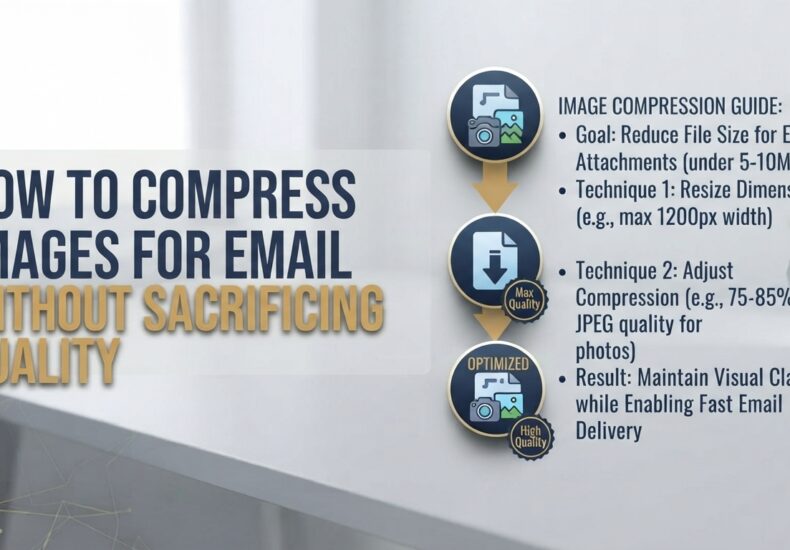
How to Compress Images for Email Without Sacrificing Quality
Email is one of the easiest ways to share photos, documents, and visual content, but large image files can make attachments difficult to send. Learning how to compress and email photos can reduce file sizes while keeping images clear enough for the recipient. A browser-based image conversion tool such as LovelyImgs can also be useful when you need to prepare images in a different format before sharing them.
Large photographs can consume attachment limits quickly, especially when several images are included in the same message. They can also take longer to upload and download. For this reason, knowing how to compress pics for email is useful for personal messages, business communication, school projects, online applications, and everyday file sharing.
Why Should You Compress Pictures Before Emailing?
Modern smartphones and cameras capture images at very high resolutions. While that quality is valuable for printing and editing, it is often unnecessary for an image that will simply be viewed inside an email or on a computer screen.
Reducing dimensions and file size can make attachments easier to manage. If you need to compress pictures for email, the goal should not necessarily be to make them as small as possible. Instead, choose a practical size that provides a good balance between visual quality and convenient file sharing.
How to Compress Pictures for Email
The first step is to identify which images actually need to be attached. Remove duplicate or unnecessary files, then check the dimensions and formats of the remaining photos.
If an image is several thousand pixels wide, resizing it can make a significant difference. You can then apply moderate compression to reduce its storage size further. Always keep a copy of the original image so that you can return to the full-resolution version later.
When an image needs to be converted as part of the process, a JPG to PNG converter can help change the file format before you attach it. However, conversion alone does not always make a file smaller, so consider the purpose of the image before choosing a format.
Choosing the Right Image Format
Image format plays an important role in email file sizes. JPG is widely used for photographs because it supports many colors and can provide relatively small files through compression. PNG, on the other hand, uses lossless compression and is particularly useful for graphics, screenshots, illustrations, and images that require transparency.
If you need to compress pics for email, remember that PNG may sometimes produce a larger file than the original JPG. The advantage is that PNG can preserve image information without the same type of lossy compression used by JPG.
For ordinary photographic attachments, JPG may be more practical when your main goal is reducing file size. For graphics where sharp edges or transparency matter, PNG may be the better choice.
Practical Ways to Compress Images for Email
There are several simple methods you can use to reduce image sizes before sending them.
Resize Large Images
Reducing the width and height of a photograph is often one of the most effective ways to reduce its file size. A photo intended for an email does not necessarily need the original resolution produced by a modern camera.
Adjust Compression Quality
For JPG photographs, reducing quality moderately can decrease file size while keeping the image visually appealing. Avoid excessive compression when important details, text, or faces need to remain clear.
Select an Appropriate Format
Use the format that matches the image. JPG is generally suitable for photographs, while PNG is useful for transparent graphics, screenshots, and images where lossless quality is important.
Avoid Repeated Compression
Repeatedly opening, editing, and saving a compressed JPG can gradually affect image quality. Keep an original copy and create an email-ready version separately.
How to Make a Picture Smaller for Email
If you only need to send a few photographs, resizing them individually may be enough. Start with the original dimensions and reduce them to a practical viewing size. Then check the resulting file size and visual quality.
For example, a very large camera photograph may be unnecessary for a simple email conversation. A smaller copy can still look sharp on a phone, laptop, or desktop display while taking up considerably less space.
If you regularly send images, consider creating a separate folder for email-ready versions. This can save time because you will not need to prepare the same files repeatedly.
JPG to PNG Conversion and Email Sharing
There are situations where converting an image before emailing makes sense. A PNG file can be useful when the image contains transparent areas, interface screenshots, logos, diagrams, or other graphical elements where lossless quality matters.
A JPG to PNG online free conversion workflow can be convenient when you need to change several JPG files into PNG format without installing desktop software. After conversion, however, check the resulting file sizes before attaching them because PNG files can sometimes be larger than JPG versions.
For photographs where file size is the priority, keeping the image as JPG and applying sensible compression may be more efficient.
How to Send Images Without Creating Unnecessary File Sizes
Before clicking the send button, review the attachments and consider whether the recipient really needs the original resolution. If the images are intended only for viewing, smaller versions are usually sufficient.
If you have many large photographs, another option is to upload the original files to a cloud-storage service and share a link. This allows recipients to access the original-quality files without placing all of that data directly into the email attachment.
For a small number of images, however, resizing and compressing the files can be the simplest approach. The right method depends on the number of images, required quality, and attachment limits of the email service.
Tips for Better Email Image Quality
Good compression is about finding the right balance rather than reducing every image as much as possible. Keep these practices in mind:
- Save original photographs separately before compression.
- Resize oversized images before attaching them.
- Use JPG for many standard photographs.
- Use PNG when transparency or lossless quality is important.
- Check the final file size before sending.
- Preview compressed images to make sure important details remain visible.
- Avoid repeatedly saving the same compressed file.
- Use cloud storage when original-resolution images are too large for attachments.
- Convert formats only when there is a practical reason to do so.
Frequently Asked Questions
1. How do I compress photos for email?
Resize large photos, select an appropriate image format, and apply moderate compression. Keep the original files separately so you can access the full-resolution versions later.
2. How can I compress images for email without losing quality?
Use moderate compression and avoid reducing the dimensions more than necessary. Comparing the compressed version with the original can help you find a suitable balance.
3. Is JPG or PNG better for email?
It depends on the image. JPG is often suitable for photographs and can provide smaller files, while PNG is useful for screenshots, graphics, transparency, and lossless image quality.
4. Does converting JPG to PNG reduce file size?
Not necessarily. PNG can sometimes produce a larger file than JPG because it uses lossless compression. The best format depends on the type and intended use of the image.
5. What is the easiest way to make images smaller for email?
Resize oversized images and use an appropriate compression level. For photographs, creating a smaller JPG copy is often a practical solution for everyday email sharing.
You may also like

Leave a Reply