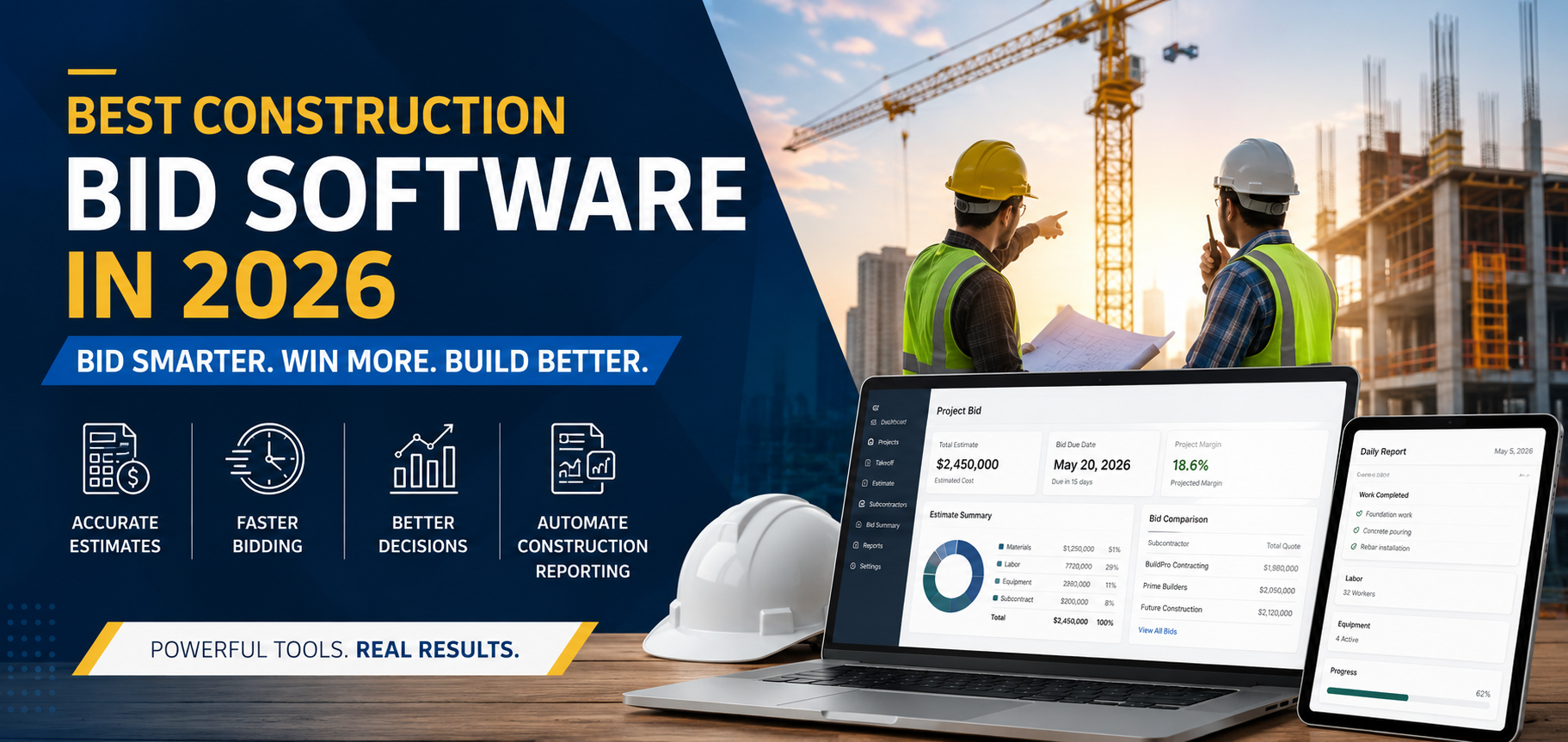
Best Construction Bid Software in 2026
Construction projects in 2026 are more competitive than ever. Margins are tighter, deadlines are shorter, and clients expect faster, more accurate proposals. In this environment, relying on spreadsheets or manual estimating is no longer enough. This is where construction bid software becomes essential for modern contractors, estimators, and project managers.
In this guide, we’ll break down what construction bid tools actually do, why they matter, and which platforms stand out in 2026. We’ll also look at how teams are using technology to automate construction reporting and improve win rates.
What Is Construction Bid Software?
Construction bid software is a digital tool that helps contractors prepare, manage, and submit project bids more efficiently. Instead of manually calculating costs, quantities, labor, and materials, the software automates much of the estimating and proposal process.
Most modern platforms include:
- Cost estimation tools
- Digital takeoff features
- Bid management dashboards
- Subcontractor comparison tools
- Proposal generation
- Integration with accounting and project management systems
In simple terms, it replaces messy manual workflows with structured, data-driven bidding.
Why Construction Bid Software Matters in 2026
The construction industry has shifted heavily toward digitization. Clients now expect:
- Faster bid turnaround times
- More accurate pricing
- Transparent breakdowns
- Real-time updates
Using construction bid software helps contractors stay competitive in three major ways:
1. Faster Bid Preparation
What used to take days in Excel can now be done in hours or even minutes.
2. Higher Accuracy
Automated calculations reduce human error in quantity takeoffs and cost estimation.
3. Better Profitability
Better estimates mean fewer cost overruns and more profitable projects.
Key Features to Look for in Construction Bid Software
Before choosing a tool, it’s important to understand what actually matters. Not every platform is built the same.
1. Digital Takeoff Tools
These allow you to measure blueprints digitally instead of manually scaling drawings.
2. Cost Databases
Preloaded material and labor cost libraries save time and improve consistency.
3. Bid Comparison
Helps evaluate subcontractor quotes side by side.
4. Collaboration Tools
Teams can work together in real time across departments.
5. Reporting Automation
Modern platforms help you automate construction reporting, generating daily logs, cost reports, and bid summaries automatically.
Best Construction Bid Software in 2026 (Honest Comparison)
Let’s look at the top platforms contractors are actually using in 2026.
1. Procore
Overview
Procore is one of the most widely used construction management platforms in the world. While it is not just bid software, its bidding and preconstruction tools are extremely powerful.
Strengths
- Strong bid management system
- Easy subcontractor communication
- Integrated project management
- Excellent document control
Weaknesses
- Expensive for small contractors
- Learning curve for beginners
Best for
Large contractors and enterprises managing multiple projects at once.
2. Autodesk Construction Cloud
Overview
Autodesk Construction Cloud is a powerful ecosystem that combines design, estimating, and project management. It includes tools like Takeoff and Bid Board for preconstruction workflows.
Strengths
- Excellent BIM integration
- Accurate quantity takeoffs
- Strong design-to-bid workflow
- Cloud-based collaboration
Weaknesses
- Can be complex for small teams
- Requires setup and training
Best for
Design-heavy construction firms and engineering-focused teams.
3. Buildertrend
Overview
Buildertrend is popular among residential builders and remodelers. It focuses on simplicity and usability.
Strengths
- Easy to use interface
- Strong client communication tools
- Bid requests and proposal tracking
- Mobile-friendly platform
Weaknesses
- Less powerful for large commercial projects
- Limited advanced estimating features
Best for
Small to mid-sized residential contractors.
4. Bluebeam Revu
Overview
Bluebeam Revu is widely used for PDF-based takeoffs and document collaboration.
Strengths
- Excellent PDF markup tools
- Fast quantity takeoffs
- Strong collaboration features
- Works well with existing workflows
Weaknesses
- Not a full bid management system
- Limited automation for reporting
Best for
Estimators who need powerful takeoff tools without switching full systems.
5. Oracle Construction and Engineering
Overview
Oracle provides enterprise-grade construction management solutions designed for mega projects and infrastructure.
Strengths
- Advanced cost control
- Strong analytics and reporting
- Enterprise scalability
- Integration with finance systems
Weaknesses
- Very expensive
- Complex setup process
Best for
Government and large infrastructure projects.
How Modern Teams Are Using AI and Automation
In 2026, the biggest shift in construction tech is automation. Teams are no longer just using tools for estimating—they are using them to automate construction reporting across the entire project lifecycle.
Here’s how automation is changing workflows:
1. Automated Daily Reports
Instead of manual site reporting, software now generates daily logs based on field inputs.
2. Cost Tracking in Real Time
Budgets update automatically as expenses are logged.
3. Bid Optimization
AI tools analyze past bids to suggest better pricing strategies.
4. Document Generation
Proposals, contracts, and RFIs are generated automatically from templates.
This reduces administrative workload significantly and allows teams to focus more on execution rather than paperwork.
Construction Bid Software vs Traditional Estimating
| Feature | Manual Method | Construction Bid Software |
|---|---|---|
| Speed | Slow | Fast |
| Accuracy | Error-prone | High accuracy |
| Collaboration | Limited | Real-time |
| Reporting | Manual | Automated |
| Scalability | Low | High |
The difference is clear: modern tools outperform manual processes in almost every area.
Common Mistakes When Choosing Bid Software
Even though construction bid software is powerful, many companies make mistakes when selecting it:
1. Choosing Based Only on Price
Cheaper tools often lack scalability.
2. Ignoring Training Needs
Complex systems require onboarding time.
3. Not Checking Integrations
If it doesn’t integrate with accounting or project tools, it creates data silos.
4. Overbuying Features
Small teams don’t need enterprise-level systems.
Future of Construction Bid Software
The future is clearly moving toward AI-driven construction ecosystems. Over the next few years, we can expect:
- Fully automated cost estimation
- AI-generated bids tailored to client profiles
- Voice-based reporting from job sites
- Predictive project risk analysis
- Deeper integration between design and bidding systems
The goal is simple: reduce manual work and increase accuracy.
Choosing Construction Bid Software Is More Than Just Digitizing Your Workflow
Choosing the right construction bid software in 2026 is not a one-size-fits-all decision. It depends heavily on how your company operates on a daily basis, the scale and complexity of your projects, your internal team structure, and how much of your workflow you want to digitize. A small residential contractor working on local remodeling jobs will naturally have very different needs compared to a large enterprise handling commercial infrastructure or multi-site developments.
For enterprise-level firms, platforms like Procore or Autodesk Construction Cloud are often the preferred choice. These systems are designed to handle complex project environments where multiple stakeholders, subcontractors, and departments need to stay aligned in real time. They provide deep integration between estimating, scheduling, document control, and financial tracking, which helps large teams maintain consistency across multiple bids and projects. However, these platforms often require structured onboarding, trained staff, and a clear internal process to fully unlock their value.
On the other hand, smaller and mid-sized contractors usually prioritize simplicity, speed, and ease of use over advanced enterprise features. Tools like Buildertrend offer a more intuitive experience that focuses on practical daily workflows such as bid requests, client communication, and project tracking. Similarly, Bluebeam Revu is highly valued for its powerful takeoff and document markup capabilities, especially for estimators who primarily work with blueprints and PDF plans. These tools allow smaller teams to stay efficient without being overwhelmed by overly complex systems.
However, regardless of the software you choose, the real advantage in 2026 is not just about digitizing your bidding process—it’s about transforming how decisions are made. Modern construction teams are no longer relying purely on manual calculations or static spreadsheets. Instead, they are shifting toward data-driven estimation models that improve accuracy and reduce financial risk across projects.
Conclusion
What matters most is not simply bidding faster, but bidding smarter with better insights and fewer errors. The right construction bid software helps contractors standardize pricing, compare subcontractor quotes more effectively, and reduce the chances of underbidding or overestimating project costs. This leads to more competitive proposals that still protect profit margins.
Another major advantage is the growing ability to automate construction reporting. Instead of spending hours compiling daily progress updates, cost summaries, and labor reports manually, modern tools can generate these reports automatically based on real-time project data. This automation not only saves time but also improves transparency between field teams, office staff, and clients. It ensures that decision-makers always have access to accurate, up-to-date information when reviewing project performance or preparing new bids.
Ultimately, the best approach is to select a platform that aligns with your current needs while also supporting future growth. As construction technology continues to evolve, companies that invest in flexible and scalable bid software will be better positioned to adapt to changing project demands, improve operational efficiency, and stay competitive in an increasingly digital construction landscape.